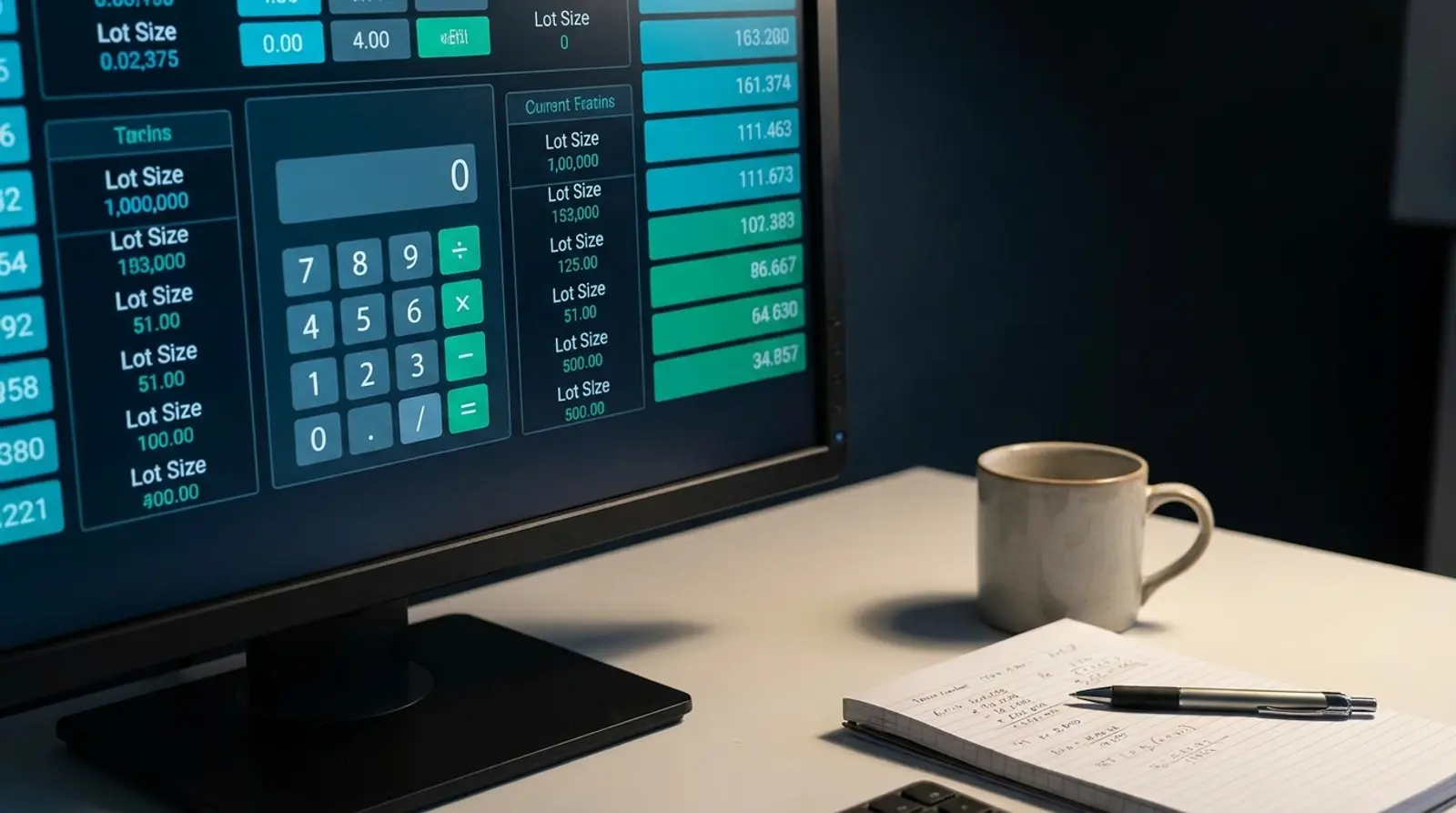
What Is a Lot in Forex? How to Calculate a Lot Size for Your Account
When you open a forex trading screen, the first thing to fill in before hitting the order is the "Lot size." Many people wonder what a lot is, what it stands for, and why 0.01 and 1.00 differ so drastically. This article explains everything about lots in plain terms with real calculations.
We will cover everything from the meaning of a lot, the various types (Standard, Mini, Micro, Nano), the pip value of each size, all the way to the key that beginners often overlook: how to choose a lot size suited to your account (position sizing), one of the most important risk-management tools.
Note: This article is for educational purposes only and is not investment advice. Forex trading carries high risk and you can lose more than your deposit. Choosing a lot size too large for your account is the main reason accounts get wiped out fast. Always study and assess the risk yourself before going live.
What Is a Lot? What Does Lot Stand For?
A lot is the standard unit used to measure the "size" of a forex trade. Because currency values move in tiny fractions, the market requires trading in standardized blocks rather than buying one unit at a time. The word "lot" in English means a "group" or "set" of goods, so in a financial context it means a set quantity of currency traded in one order.
The market standard is 1 Standard Lot = 100,000 units of the base currency. For example, trading EUR/USD at 1 Lot means you are trading the equivalent of 100,000 euros. That number sounds enormous, but thanks to leverage you do not need 100,000 euros of real money to open an order this size.
In practice, retail traders do not always trade a full 1 Lot but choose smaller sizes, such as 0.1 Lot or 0.01 Lot, to control risk. The number you enter in the "Volume" field on the MT4/MT5 platform is this Lot size.
Types of Lot: Standard, Mini, Micro, Nano
Lots come in several sizes to suit traders with different capital and risk levels. The table below summarizes each type, along with the number of units and the approximate value per 1 pip (referencing pairs quoted in dollars, such as EUR/USD).
| Lot type | Size (Lot) | Number of units | Value per pip (approx.) |
|---|---|---|---|
| Standard Lot | 1.00 | 100,000 | ~10 USD |
| Mini Lot | 0.10 | 10,000 | ~1 USD |
| Micro Lot | 0.01 | 1,000 | ~0.10 USD |
| Nano Lot | 0.001 | 100 | ~0.01 USD |
Pip Value of Each Lot
Pip value is the amount you gain or lose when the price moves 1 pip, and it is directly proportional to the Lot size — the larger the Lot, the higher the pip value. This is why the choice of Lot size directly affects risk.
For pairs quoted in dollars (such as EUR/USD, GBP/USD), the pip value is easy to calculate: 1 Standard Lot ≈ $10/pip, 1 Mini Lot ≈ $1/pip, and 1 Micro Lot ≈ $0.10/pip. For example, if you open 0.10 Lot and the price moves 30 pips in your favor, you profit about 30 × 1 = $30.
One caveat: pairs not quoted in dollars (such as USD/JPY or Cross pairs) have a slightly different pip value depending on the exchange rate. Most platforms calculate this automatically, but understanding the principle helps you assess risk more accurately.
How to Calculate a Lot Size for Your Account (Position Sizing)
Position sizing is setting your Lot size to fit the risk you can accept per order, instead of guessing or opening a Lot on feel. This is one of the skills that separates traders who survive from those who blow their accounts fast. The principle is to set the "amount you are willing to lose" first, then work backward to the Lot.
- 1Set the risk percentage per trade — e.g. no more than 1–2% of your account per order
- 2Convert to a money amount — e.g. a $1,000 account risking 2% = $20 you can lose per trade
- 3Set the Stop Loss distance in pips — e.g. the exit point is 20 pips away
- 4Calculate the acceptable pip value — take the money you can lose ÷ SL distance = 20 ÷ 20 = $1/pip
- 5Convert to a Lot size — a pip value of $1 = about 0.10 Lot (Mini Lot)
The Relationship With Leverage and Margin
Lot size, leverage, and margin are inseparably linked. The Lot size sets the order value (e.g. 0.1 Lot = 10,000 units), while leverage sets how much margin you must put up to open that order. The larger the Lot, the more margin required and the narrower the room your account can withstand a loss.
A common beginner mistake is seeing that the broker offers high leverage and opening a large Lot because "there is enough margin," forgetting that enough margin does not mean safe — because with a large Lot the pip value is also high, so a move of just a few pips against you can eat up your capital.
The correct approach is to let "risk per trade" determine the Lot size, not the margin or leverage. Leverage is merely the tool that lets you open an order, while the appropriate Lot size must always come from your risk-management plan.
A Real Example: Choosing a Lot by Account Size
Let us look at a concrete example of how traders with different account sizes should consider their Lot size, based on the principle of risking 2% per trade and setting a Stop Loss at 20 pips (this is only an educational example, not a recommendation to follow).
| Account size | Risk 2% per trade | SL 20 pip | Approximate Lot size |
|---|---|---|---|
| 100 USD | 2 USD | 0.10 USD/pip | 0.01 (Micro) |
| 500 USD | 10 USD | 0.50 USD/pip | 0.05 |
| 1,000 USD | 20 USD | 1 USD/pip | 0.10 (Mini) |
| 5,000 USD | 100 USD | 5 USD/pip | 0.50 |
Cautions About Lot Size
Choosing a Lot size too large for your account is one of the top reasons beginner traders lose heavily, because even with a good strategy, if the Lot is too big, a normal price fluctuation can hit your account so hard you have to close the order before the plan can work.
- Do not increase your Lot to "win it back" after a loss — this behavior (undisciplined Martingale) accelerates blowing the account
- Beware of high-impact news periods — the price can jump many pips in seconds and a large Lot will lose more than expected
- Check the pip value of the pair you trade — highly volatile pairs or those not quoted in dollars may behave differently than you think
- Always stick to your position sizing plan — keep risk per trade equal on every order and do not trade on emotion
When Running an EA That Auto-Manages Lot Size — Why You Need a VPS
Many EAs (Expert Advisors) have a function that calculates and adjusts Lot size automatically based on your account and the risk you set, reducing errors from entering the Lot by hand. But an EA only works when MT4/MT5 is open and connected to the internet at all times. If you run it on a home PC, a single power cut or dropped connection stops the EA from calculating and it may miss the moment to open/close orders.
For this reason, EA traders favor a Forex VPS — a virtual server that stays on 24 hours a day in a data center, with backup power and internet and low ping, letting the EA run and manage Lot size continuously even when your home PC is off, and accessible remotely from anywhere. This is the infrastructure that lets your risk-management plan work in practice around the clock.
Let Your EA Manage Lot Size Continuously, 24 Hours
When running an EA that calculates Lot size automatically, you need a server on at all times — Plusweb Forex VPS is on 24/7 with low ping, supports MT4/MT5 · Windows Server · from ฿250/mo, activated automatically within minutes
Frequently Asked Questions
What is a lot and what does it stand for?
A lot is the standard unit used to measure trade size in forex. The word "lot" in English means a group or set of goods, so in trading it means a set quantity of currency traded in one order, where 1 Standard Lot = 100,000 units of the base currency.
How many units is 1 Lot?
1 Standard Lot = 100,000 units, 1 Mini Lot (0.10) = 10,000 units, 1 Micro Lot (0.01) = 1,000 units, and 1 Nano Lot (0.001) = 100 units of the base currency. Beginners often start at a Micro Lot to limit risk.
What lot size should beginners start with?
Most advice is to start at a Micro Lot (0.01) because the pip value is only about $0.10, letting you practice real trading with limited risk. You should also use position sizing to set the Lot size based on the risk you can accept per trade.
How do I calculate a lot size suited to my account?
Set the risk percentage per trade (e.g. 1–2% of the account), convert it to the money you can lose, then divide by (Stop Loss distance in pips × pip value of 1 Lot) to get the appropriate Lot size. This makes every trade risk the same amount.
Does an EA that auto-manages Lot size need the computer left on?
If you run it on a home PC, yes, and you risk power cuts/dropped connections that stop the EA from calculating Lot size. EA traders therefore favor a Forex VPS that is on 24/7 with low ping, so the EA manages Lot size continuously without leaving your own computer on.
GUIDES
Related articles
Keep reading on similar topics

What Is Leverage in Forex? Explained With Worked Examples
Understand leverage from the ground up — its meaning, how to calculate it, its relationship to Margin and Margin Call, a comparison of 1:100 vs 1:500 vs 1:1000, and the risk-management principles beginners must know before using it live.
Read more
What Is Spread in Forex? The Hidden Cost Traders Must Understand
Understand spread from the ground up — its meaning, Bid/Ask, wide vs narrow spreads, the difference between Fixed and Floating spread, the hidden costs of Spread + Commission + Swap, why spreads widen during news, and how it relates to speed and latency.
Read more
What Is Forex? How to Start Trading — Beginner's Guide 2026
A complete beginner's roundup — what forex is, what forex trading involves, how the foreign exchange market works, plus the basic terms (currency pairs, pip, lot, leverage, spread), how to start safely, and the risks you must know before going live.
Read more