Every time you open a forex order, you will notice it goes slightly negative from the very first second. That is not an error — it is the Spread. Many people wonder what spread means, what it is, and why it is a "hidden cost" that eats into profit without our noticing. This article explains everything in plain terms.
We will look at everything from what Spread means and the Bid/Ask prices, the difference between Fixed and Floating spread, the three hidden costs a trader must include in their plan (Spread + Commission + Swap), why spreads widen during major news, and the point beginners often overlook: how the speed of sending your order (latency) relates to your true cost.
Note: This article is for educational purposes only and is not investment advice. Forex trading carries high risk and you can lose more than your deposit. Always study carefully and assess the risk yourself before going live.
What Is Spread? What Does Spread Mean?
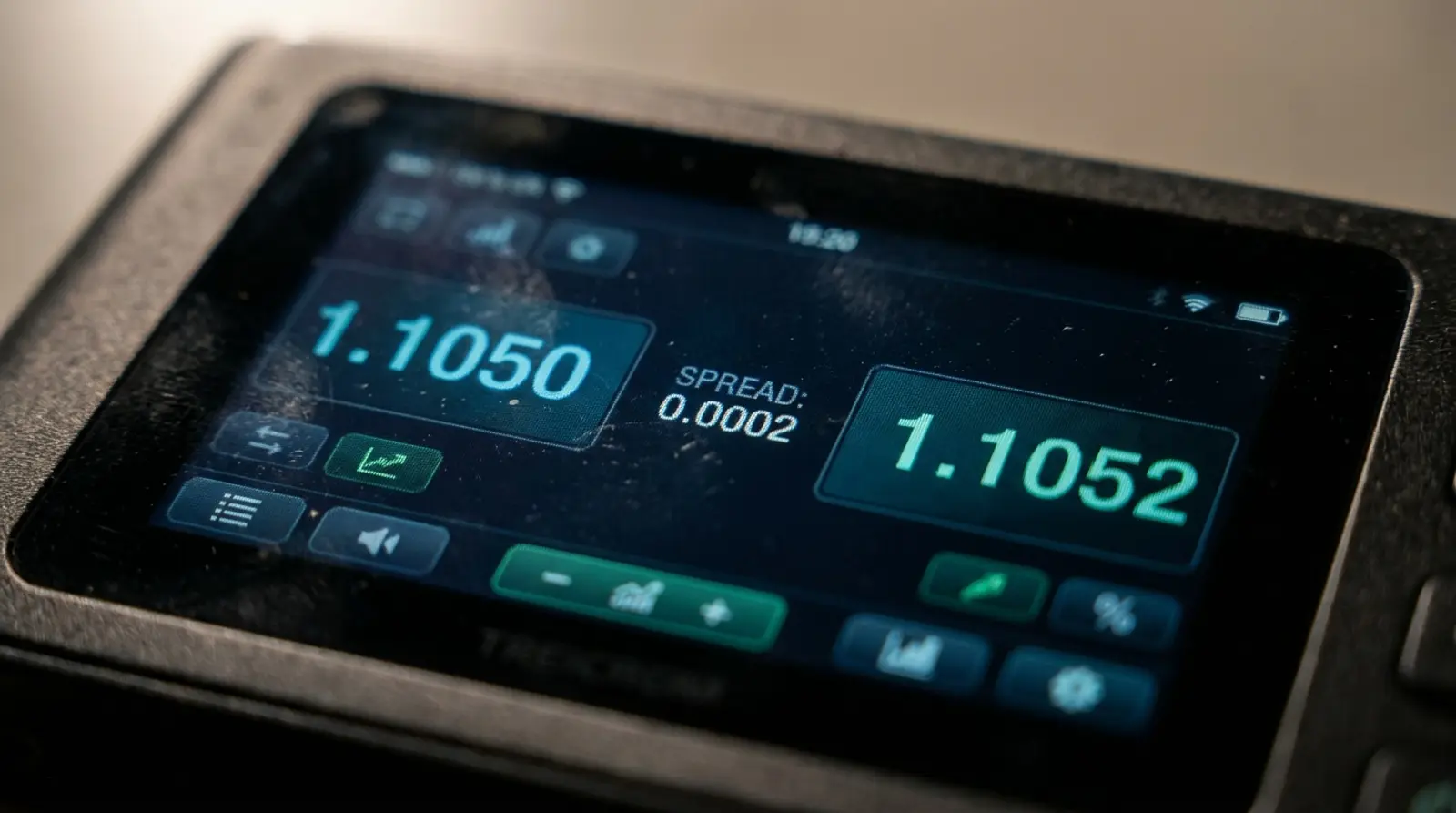
Spread literally means "difference." In forex trading, the Spread is the difference between the buy price (Ask) and the sell price (Bid) of a given pair at the same moment. It is the broker's main compensation for acting as intermediary and is the first cost a trader pays on every order.
Every pair always has two prices: Bid is the price you can "sell" at, and Ask is the price you can "buy" at, with Ask always slightly higher than Bid. For example, if EUR/USD has Bid = 1.0850 and Ask = 1.0852, the difference of 0.0002, or 2 pips, is the Spread. When you open a Buy at the Ask price, the order starts negative by exactly the Spread, and the price must move beyond the Spread before you begin to profit.
The Spread is counted in pips (or points). The narrower the Spread, the lower the cost. Highly liquid major pairs like EUR/USD usually have a narrow Spread, while low-liquidity Exotic pairs often have a much wider one.
How Bid / Ask Works
Understanding Bid/Ask clearly lets you read the cost of each order immediately. Bid is the price the market (through the broker) is willing to "buy" from you, so when you want to sell, you get this price. Ask is the price the market is willing to "sell" to you, so when you want to buy, you pay this price.
Because you buy at the high price (Ask) but would sell at the low price (Bid) if you closed immediately, this difference is what you "pay" the broker from the outset. That is why every order starts slightly negative, whether you Buy or Sell.
The Spread figure is therefore the first thing to check before choosing a pair or a trading time, especially for scalpers who open and close orders often and take only a few pips at a time — the accumulated Spread cost becomes very significant.
How Fixed vs Floating Spread Differ
Spread comes in two main forms brokers offer: Fixed and Floating. The table below compares the two to make the pros and cons clear.
| Topic | Fixed Spread | Floating Spread |
|---|---|---|
| Spread value | Constant regardless of the market | Changes with market liquidity |
| Normal market conditions | May be slightly wider | Usually narrower |
| News/volatile periods | Constant (but may face requotes) | Widens temporarily |
| Cost predictability | Easy, cost known in advance | Harder, must allow a buffer |
| Best for | Those wanting a certain cost | Those trading in high liquidity |
Hidden Trading Costs: Spread + Commission + Swap
Spread is only the first cost. Assessing your true cost requires combining three parts, otherwise you may think a strategy is profitable when hidden costs have actually eaten all the profit.
- Spread — the Bid/Ask difference paid on every order; the more frequently you trade, the more it accumulates
- Commission — a per-trade fee, usually charged on ECN/Raw Spread accounts where the Spread is very narrow, so the broker collects commission instead (e.g. charged per Lot on both entry and exit)
- Swap — overnight interest added or deducted when you hold an order across the day, calculated from the interest rate difference between the two currencies; it can be positive or negative, so long-term traders (holding several days) must account for it carefully
Why Spreads Widen During News
If you have ever traded during a major economic release (such as employment figures or a central bank meeting), you will have noticed the Spread widen rapidly within seconds. The reason is that during that period the market is highly volatile and liquidity temporarily drops, so liquidity providers widen the difference to protect against the risk of rapidly jumping prices.
The impact on traders is that the cost per order rises temporarily, and if you set a narrow Stop Loss, the widened Spread may hit your Stop Loss sooner than expected. Slippage can also occur — your order is matched at a price different from what you clicked, because the price moves too fast for the order to keep up.
This is why many traders avoid opening new orders in the seconds a news release comes out, or if they do trade the news, they always allow for a wide Spread and slippage risk in their plan.
How Spread Relates to Speed / Latency
A point beginners often overlook is that the true cost depends not only on the Spread figure the broker advertises, but also on how fast your order "reaches" the broker's server. This delay is called Latency (measured in milliseconds) — the lower, the better.
When Latency is high (for example, slow home internet or being far from the broker's server), the order you click may reach the market after the price has already moved. The result is more frequent slippage or requotes (the broker offering a new price), making your true cost higher than the Spread you see — especially for scalpers and EA users who need second-level precision.
For those running an EA or trading short-term strategies sensitive to speed, reducing Latency is something you can control through infrastructure. The popular method is placing the server running your platform near the broker's server via a Forex VPS with low ping, which helps orders arrive faster and reduces controllable slippage.
Reduce Controllable Costs With a Forex VPS
In summary, some trading costs are beyond our control, such as the Spread widening during news or the market Swap rate. But there are technical costs we can manage — namely latency and connection continuity — which affect true cost through slippage and the chance of an EA missing a moment.
A Forex VPS is a virtual server that stays on 24 hours a day in a data center, with backup power and internet, low ping, and often located near the broker's server, so orders arrive faster and MT4/MT5 or your EA runs continuously even when your home PC is off. For scalpers or EA users where hidden cost and speed matter, this is the infrastructure that reduces controllable risk factors so you can focus on strategy instead.
Reduce Controllable Latency and Slippage
For scalpers and EA users where speed and continuity matter — Plusweb Forex VPS is on 24/7 with low ping, near the broker's server, supports MT4/MT5 · Windows Server · from ฿250/mo, activated automatically within minutes
Frequently Asked Questions
What does spread mean in forex?
Spread means "difference." In forex trading it refers to the difference between the buy price (Ask) and the sell price (Bid) of a pair at the same moment. It is the broker's main compensation and the first cost a trader pays on every order.
Why does my order start negative when I open it?
Because you buy at the Ask (higher) but would sell at the Bid (lower) if you closed immediately. That difference is the Spread paid to the broker, so the price must move beyond the Spread before the order begins to profit.
Should I choose Fixed or Floating spread?
Fixed spread gives a certain, easy-to-predict cost but is usually slightly wider, suiting those wanting certainty. Floating spread is usually narrower in normal conditions but widens during news, suiting those trading in high liquidity. Choose based on your trading style.
What is Swap in forex trading?
Swap is the overnight interest added or deducted when you hold an order across the day, calculated from the interest rate difference between the two currencies in the pair. It can be positive or negative, so traders holding orders for several days must count it as a cost.
What does latency have to do with trading cost?
Latency is the delay in sending orders to the broker's server. The higher it is, the more risk of slippage and requotes, making your true cost higher than the Spread you see. Scalpers and EA users therefore favor a Forex VPS with low ping so orders arrive faster and controllable slippage is reduced.
GUIDES
Related articles
Keep reading on similar topics

What Is Leverage in Forex? Explained With Worked Examples
Understand leverage from the ground up — its meaning, how to calculate it, its relationship to Margin and Margin Call, a comparison of 1:100 vs 1:500 vs 1:1000, and the risk-management principles beginners must know before using it live.
Read more
What Is a Lot in Forex? How to Calculate a Lot Size for Your Account
Understand lots from the ground up — the meaning, the Standard/Mini/Micro/Nano types, the pip value of each size, how to calculate a lot size suited to your account (position sizing), and its relationship to leverage and margin, with real examples.
Read more
What Is Latency, Why It Matters for Running EAs & How to Lower It
Understand latency (ping) in plain terms — how it is measured in ms, why low latency helps your EA and scalping fill orders faster and cut slippage, plus how to test and genuinely reduce forex latency.
Read more