Minecraft 26.3 Wilderness Bound: Everything New and What Server Owners Must Do
Minecraft released the third game drop of 2026, named Wilderness Bound, on September 15, 2026 — Java Edition 26.3 and Bedrock Edition 26.50. It arrived roughly three months after Chaos Cubed (June 16, 2026), matching the current four-drops-a-year cadence. The theme this time is getting out of your base: a new autumn biome, campsite furniture, and a structure that hands you maps to other treasure.
The first half of this guide is a fast summary of everything new. The second half is for anyone running a server for friends, because this drop changes things server-side that will either stop your server from starting or quietly lock every player out.
Wilderness Bound at a glance
| What's new | What it is | Why it matters |
|---|---|---|
| Dappled Forest | A permanent-autumn biome generating near cold biomes | Source of poplar wood and shelf mushrooms |
| Poplar tree | New wood type with red, orange and yellow leaves | Full wood set; planks and stripped logs are grey |
| Cushion | Crafted from 3 wool slabs, in all 16 colors | You can actually sit on it — seating for builds |
| Straw Bed | 3 hay bales make 4 beds, single use | Skip the night without moving your spawn point |
| Abandoned Camp | Structure generating in 18 biomes | Loot chests plus explorer maps to other structures |
| Wool / concrete stairs and slabs | All 16 colors of each | A much wider building palette |
The Dappled Forest and poplar wood
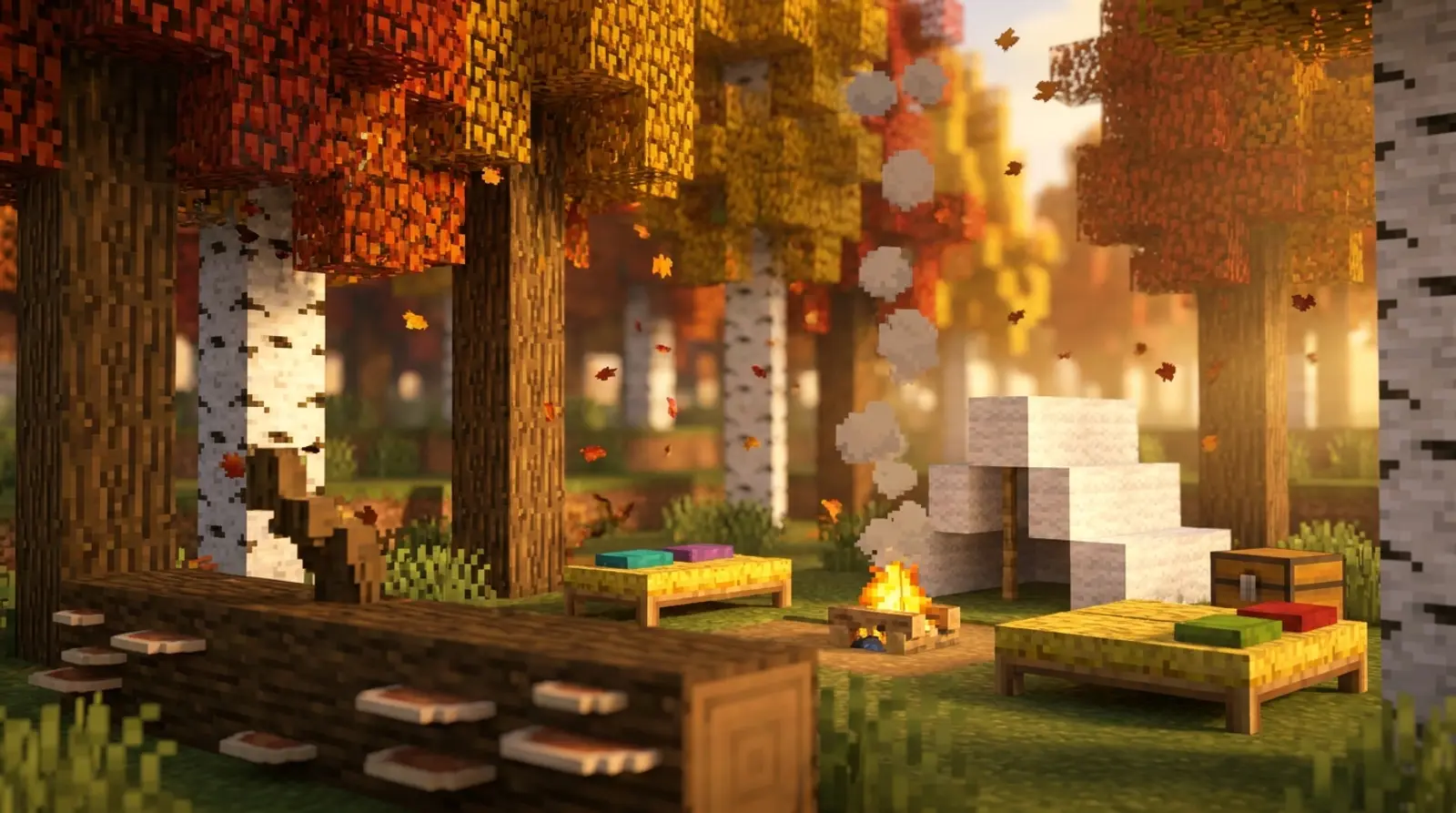
The Dappled Forest is an autumn forest that never changes season, inspired by the fall forests of Michigan. Inside you will find standing and fallen poplar trees (fallen ones are more common here than in other biomes), red shrubs, leaf litter, brown mushrooms, and shelf mushrooms growing out of poplar trunks.
Poplar leaves come in red, orange and yellow, each with falling-leaf particles in its own color, and a sapling grows into a random color. Wandering Traders sell both poplar saplings and shelf mushrooms. The wood set is complete — logs, planks, stairs, slabs, signs, doors, fences, trapdoors, shelves and boats — and stripping or crafting it produces grey planks, a tone no other wood set gives you.
Shelf mushrooms come in two sizes; bone meal turns a small one into a large one, and breaking a large one drops two. They bounce like a bed and can be used in mushroom, suspicious and rabbit stew. Red shrubs stay red in every biome, work in a composter, and spread with bone meal.
Cushions and straw beds
A cushion is crafted from three wool slabs of one color. You sit on it the way you mount a horse and press Shift to get up, and while seated you can still look around, use nearby blocks and fight. Technically it is an entity rather than a block, so it has no collision, pistons cannot push it, and it breaks if the block underneath is removed.
A straw bed comes three hay bales for four beds. It lets you sleep through the night without changing your spawn point, but it is destroyed after one use — even if you leave the bed early. Placed in the Nether or the End it breaks instead of exploding.
Abandoned camps and the new explorer maps
Abandoned camps generate in 18 biomes, including Meadow, Cherry Grove, Forest, Taiga, Swamp, Savanna, Pale Garden and the new Dappled Forest. Every camp has a tent built from white wool stairs, straw beds, cushions and a campfire, with the design varying by biome. Loot sits in chests or barrels, and a camp may hide an oxidized copper chest.
Ordinary camp chests hold maps to camps in eight other biomes. The hidden chest holds maps to bigger structures: Buried Ancient City, Buried Mineshaft, Desert Pyramid and Warm Ocean Ruins. Separately, every explorer map is now its own item with its own icon, explorer and buried treasure maps can no longer be zoomed out, and the player marker on a map now shows which way you are facing.
Other changes worth knowing
- Wool and concrete now craft into stairs and slabs in all 16 colors (concrete also works in a stonecutter).
- Mushroom stew and suspicious stew accept any two mushrooms.
- Spectators can use portals.
- Endermen and shulkers no longer teleport onto bedrock, and armadillos do not roll up underwater.
- Persistent mobs stop wandering when no player is nearby, which slightly reduces server load.
- Java: faster structure location and chunk generation, and the game now uses SDL3 instead of GLFW, defaulting to borderless fullscreen.
Three things to check before upgrading a server to 26.3
If you run a Java server for friends, check these before you click upgrade. The second one is the reason people will message you saying they cannot get in.
- 1Java 25 is required — Java Edition 26.3 needs Java SE 25 or newer. If your host still runs Java 21 the server will not start at all; change the runtime first.
- 2white-list now defaults to true — in server.properties the white-list value ships as true, so a freshly generated server only admits listed players. Either run /whitelist add <player> for each friend, or set white-list=false if the server is meant to be open.
- 3Back up the world first — opening an old world in a new version upgrades it immediately and there is no way back. Copy the entire world folder before you start, in case a plugin or mod is not ready.
Plugins, mods and Bedrock players
If your server runs Paper, Spigot, Fabric or Forge, wait until both the server software and the plugins or mods you depend on publish 26.3 builds. That usually trails the official release by days to weeks. The safe move is to stay on your current version and upgrade once the plugins you actually use are ready.
Pack formats changed too (data pack 121.0, resource pack 97.1), so older packs may warn about version mismatch. And if Bedrock friends join through Geyser, wait for Geyser to support both Java 26.3 and Bedrock 26.50, since both sides have to match before anyone can connect.
If you are not in a hurry, test on a copy: spin up a 26.3 server against your backed-up world, walk around, check each plugin, then move the real server across. That way the main world is never at risk.
The previous drop and the next one
The previous drop was Chaos Cubed (Java 26.2, June 16, 2026), which added the Sulfur Caves biome, the Sulfur Cube mob that absorbs a block and then behaves according to it, sulfur and cinnabar block families, and surface geysers.
With four drops a year roughly three months apart, the next one is likely around mid-December 2026, though Mojang has not announced a name or date.
Run 26.3 without configuring Java yourself
Minecraft hosting with version selection, one-click Modpacks / Versions installs, JAVA and BEDROCK support, a Thailand datacenter for low ping, from ฿150/month.
Frequently Asked Questions
When did Minecraft Wilderness Bound release and what version is it?
It released on September 15, 2026 as the third game drop of 2026 — Java Edition 26.3 and Bedrock Edition 26.50. It arrived on PC first, with consoles following shortly after.
How is a straw bed different from a normal bed?
A straw bed lets you sleep through the night like a normal bed but does not change your spawn point, and it is destroyed after a single use. Three hay bales craft four of them, so they are made to carry while exploring.
Will the Dappled Forest appear in my existing world?
Only in chunks that have never been generated. Terrain you have already explored stays as it is, so you need to travel out into fresh land — or start a new world — to find the biome and abandoned camps.
My server will not start after upgrading to 26.3 — why?
The most common cause is an old Java runtime: Java Edition 26.3 requires Java SE 25 or newer. The other common cause is a plugin or mod that does not support the new version yet. Check the startup log and remove whatever throws an error.
My friends cannot join and get a whitelist message — what changed?
In 26.3 the white-list setting in server.properties defaults to true. Either add each player with /whitelist add <player>, or set white-list=false and restart if you want the server open to anyone with the address.
GUIDES
Related articles
Keep reading on similar topics
How to Make a Minecraft Server to Play with Friends (Full Guide)
Want to run a Minecraft server with friends but don't know where to start? This article covers 2 options — self-hosting on your PC vs. renting a server — with pros and cons, step-by-step setup, a RAM-by-player-count table, and how to install mods.
Read more
Whitelist + OP and How to Manage a Minecraft Server (2026 Edition)
Opened a Minecraft server and strangers keep griefing it? This article teaches you to set up a Whitelist to limit who joins, grant OP admin rights, ban troublemakers, plus how to keep your server safe — backups, RAM/lag management, and preventing griefing.
Read more
How to Install Plugins + Set Up a Minecraft Server (2026 Edition)
Want your Minecraft server to have more features? This article teaches you to set up a server with Spigot/Paper, edit server.properties, install plugins step by step, plus recommended popular plugins EssentialsX WorldEdit LuckPerms Vault and spec-tuning tips.
Read more