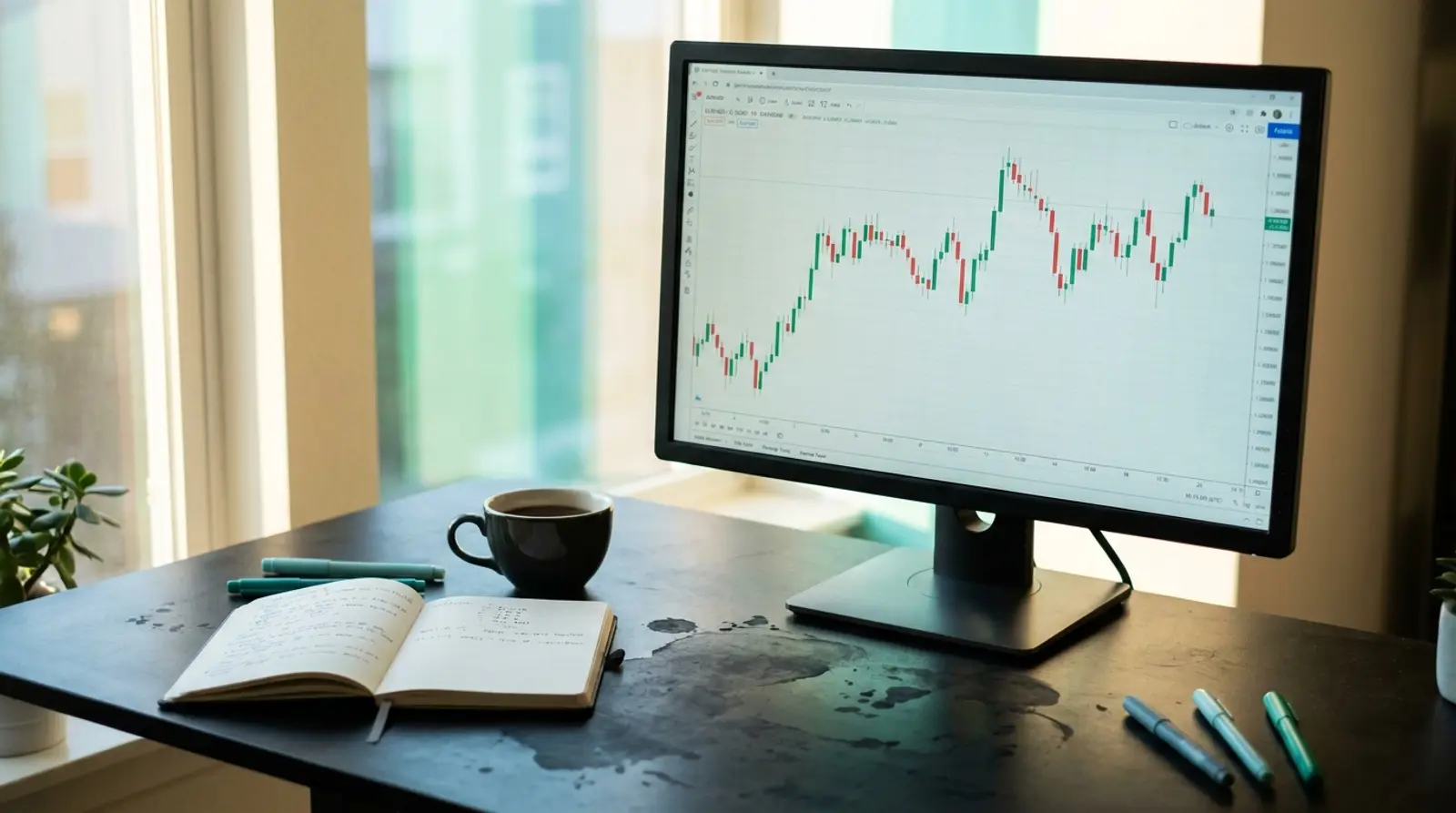
If you have just heard the word Forex and wonder what forex is, what forex trading actually involves, whether it really makes money, and how a beginner should start safely, this article explains everything from zero in plain language — no prior finance background needed.
We will cover everything from what forex means, how the foreign exchange market works, the basic terms you will meet (currency pairs, bid/ask, pip, lot, leverage, spread), the steps to start trading as a beginner in 2026, the difference between manual trading and automated (EA) trading, and most importantly the "risk" you must understand before deciding.
Note: This article is for educational purposes only and is not investment advice. Forex trading carries high risk and you can lose your entire deposit. Always study carefully and assess the risk yourself before going live.
What Is Forex?
Forex (short for Foreign Exchange) is the foreign currency exchange market — a market where people worldwide trade one currency for another, such as using US dollars to buy euros or using Thai baht to buy yen. Every time you exchange money for an overseas trip, you are actually "trading forex" in a simple form.
In investment terms, forex trading means speculating on the "difference in currency value." In other words, if you expect one currency to strengthen against another, you buy it, then sell when the rate moves as you predicted. Your profit (or loss) comes from the difference in the price change.
The forex market is the largest financial market in the world, with very high liquidity, and it is open 24 hours a day, Monday to Friday, because trading flows continuously across global financial centers, from Sydney and Tokyo to London and New York.
How a Currency Pair Works
In forex you never trade a single currency on its own — you always trade a "pair," because exchanging money requires two currencies to compare. For example, EUR/USD is the euro against the US dollar, where the first currency (EUR) is called the base and the second (USD) the quote.
The pair's price tells you how much of the quote currency it takes to buy 1 unit of the base. For example, if EUR/USD = 1.0850, it means 1 euro buys 1.0850 dollars. If you think the euro will strengthen, you "Buy" the pair; if you think it will weaken, you "Sell."
- Major pairs — pairs that include the US dollar and have high liquidity, such as EUR/USD, GBP/USD, USD/JPY
- Minor / Cross pairs — pairs without the US dollar, such as EUR/GBP, EUR/JPY
- Exotic pairs — paired with an emerging-market currency, often highly volatile with wide spreads
Basic Terms Beginners Must Know: bid/ask, pip, lot, leverage, spread
Before you start trading for real, there are just a few terms you will meet on every platform. Understand these five first and the rest becomes much easier.
- Bid / Ask — Bid is the price the market buys at (you sell at this price), and Ask is the price the market offers to sell at (you buy at this price); the two are always different
- Spread — the difference between Bid and Ask, considered a trading cost paid to the broker; the narrower the spread, the better
- Pip — the smallest unit of price change for a pair, usually the 4th decimal place (e.g. from 1.0850 to 1.0851 is a move of 1 pip); used to measure an order's profit/loss
- Lot — the size of a trade; 1 Standard Lot = 100,000 units of the base currency; beginners often start at a Micro Lot (0.01) to limit risk
- Leverage — the ratio by which the broker lends you funds to open large orders with little capital; e.g. 1:100 means 1 unit of your money controls 100 units of value
What Forex Trading Profits (and Loses) From
Profit or loss in forex trading comes from whether the pair's price moves in the direction you opened your order. If you Buy and the price rises, you profit; if it falls, you lose — and the reverse for a Sell. The size of the profit/loss depends on the number of pips the price moves multiplied by the Lot size you opened.
Many factors move a pair's price, such as each country's economic figures, central bank interest rate policy, political events and major global news, plus market psychology and emotion. These factors are hard to predict, so prices can fluctuate at any time.
A key point beginners often overlook is the "cost" of trading — the Spread, commission, and Swap (overnight interest). These costs eat into profit, so you must always factor them into your trading plan.
How to Start Trading Forex as a Beginner in 2026
For anyone who wants to start systematically and cautiously, here is the recommended step-by-step sequence, especially practicing on a demo account until proficient before using real money.
- 1Study the basics first — the meaning of currency pairs, the terms, and most importantly the "risk"; do not rush to deposit money based on ads claiming easy profits
- 2Choose a trustworthy broker — check that it holds a license from a recognized regulator, has transparent reviews, clear deposits/withdrawals, and real, reachable support
- 3Open an account and verify your identity — fill in your details and verify documents as the broker requires (KYC)
- 4Practice on a demo account first — trade with simulated money, get familiar with the platform (such as MT4/MT5), and test strategies without risking real money until you are confident
- 5Plan your trades and manage risk — set the money you can afford to lose, use a Stop Loss on every order, limit risk per trade to a small share of your account, and never trade on emotion
- 6Start with a small amount of real money — when ready, begin with the smallest Lot size (Micro Lot) and money you can accept losing entirely
Manual Trading vs Automated (EA) Trading
Forex trading can be done two main ways. The first is "manual trading," where you analyze and open/close orders yourself. It suits people who want to learn the market deeply and have time to watch the screen, but it takes a lot of time and is easily disturbed by emotion.
The other is "automated trading" through a program called an EA (Expert Advisor), a script with conditions that opens and closes orders for you according to a defined strategy. The advantage is that it works by the rules with discipline, without emotion, and runs continuously even when you are not watching the screen.
However, an EA is not a money printer. It is only as good as the strategy and settings behind it. If the market changes character, an EA can lose too, so you must test it (backtest/demo) and monitor its results regularly.
| Topic | Manual | Automated (EA) |
|---|---|---|
| Decisions | You click and analyze yourself | The program follows conditions |
| Emotion | Can be disturbed by emotion | Follows rules, no emotion |
| Time required | Must watch the screen | Runs continuously for you |
| Watch out for | Discipline and consistency | Machine must run 24/7 |
The Risks of Forex You Must Know Before Starting
Before any decision, understand clearly that forex trading carries high risk and does not guarantee profit. Many traders lose money, especially at the start. Prices can move against your prediction rapidly, and leverage accelerates losses even faster.
This article is for educational purposes only and is not investment advice or a solicitation to trade. Investment decisions are your own responsibility. Trade only with money you can afford to lose, study thoroughly, and if unsure, consult a licensed financial professional.
- You can lose your entire deposit — especially when using high leverage
- Markets are volatile due to news and hard-to-predict events
- Beware of scammers and pitches claiming guaranteed returns/profit — no investment can truly guarantee profit
- Hidden costs (Spread, commission, Swap) eat into returns
When You Are Ready to Trade With an EA — Why You Need a VPS
When you step into automated (EA) trading, you hit one limitation immediately: an EA only works when the trading program (MT4/MT5) is open and connected to the internet at all times. If you run it on a home PC, a single power cut, dropped connection, or Windows restart stops the EA and you may miss key moments.
The solution most EA traders use is a Forex VPS — a virtual server that stays on 24 hours a day in a data center, with backup power and internet, letting your EA run continuously without leaving your home PC on, and accessible remotely from anywhere. This is what to study next when you are ready to move into automated trading.
Ready to Trade With an Automated System (EA)?
When you are ready to run an EA, you need a Forex VPS running 24 hours — Plusweb Forex VPS supports MT4/MT5 · Windows Server · high uptime · from ฿250/mo, activated automatically within minutes
Frequently Asked Questions
What is forex, in simple terms?
Forex is the foreign currency exchange market, where people worldwide trade one currency for another. Forex trading is speculating on the value difference when a pair's price moves. It carries risk and you can lose money.
How much money do you need to start trading forex?
Some brokers let you open a real account with just a few hundred to a few thousand baht, but the advice for beginners is to practice on a demo account (simulated money) until proficient, then start with a small amount you can afford to lose. Never trade with money you need to live on.
Should beginners trade manually or use an EA?
At the start you should learn the basics and practice manual trading on a demo account to understand the market and risk management. Once you understand it well, then consider an EA. Note that an EA does not guarantee profit and must be tested and monitored regularly.
Can forex trading guarantee profit?
No. Forex trading carries high risk and you can lose your deposit. No system, strategy, or EA can truly guarantee profit. If anyone claims guaranteed returns, be careful — it may be a scam.
If I use an EA, must I leave my computer on all the time?
If you run it on a home PC, yes, and you risk power cuts/dropped connections. Most EA traders therefore use a Forex VPS that is on 24/7 in a data center, so the EA runs continuously without leaving your own computer on.
GUIDES
Related articles
Keep reading on similar topics
What Is a Forex EA? How It Works, Is It Safe, and How to Run It Without Drops
A complete guide to the Forex EA (Expert Advisor) — what it is, how it works on MT4/MT5, how many types there are, whether it's safe, plus the red flags of dream-selling EAs and why an EA needs to run 24/7 on a VPS.
Read more
What Is a Forex VPS? Why Every EA Trader Should Have One
Everything a trader needs to know about a Forex VPS — what it is, how it differs from a regular VPS, whether it can really run an EA on MT4/MT5 24/7, plus how to choose one that is worth it and avoid getting burned.
Read more
Best Forex VPS 2026: How to Choose Right and Not Miss Out
Where should you get a Forex VPS? The 2026 buyer's guide — 8 decision criteria, a checklist table, traps to avoid (free/oversold/no SLA), and the Forex VPS with the best value for money.
Read more